
How Can a Sinner Stand Right Before a Holy God?
Understanding Justification, Faith, and the Place of Good Works
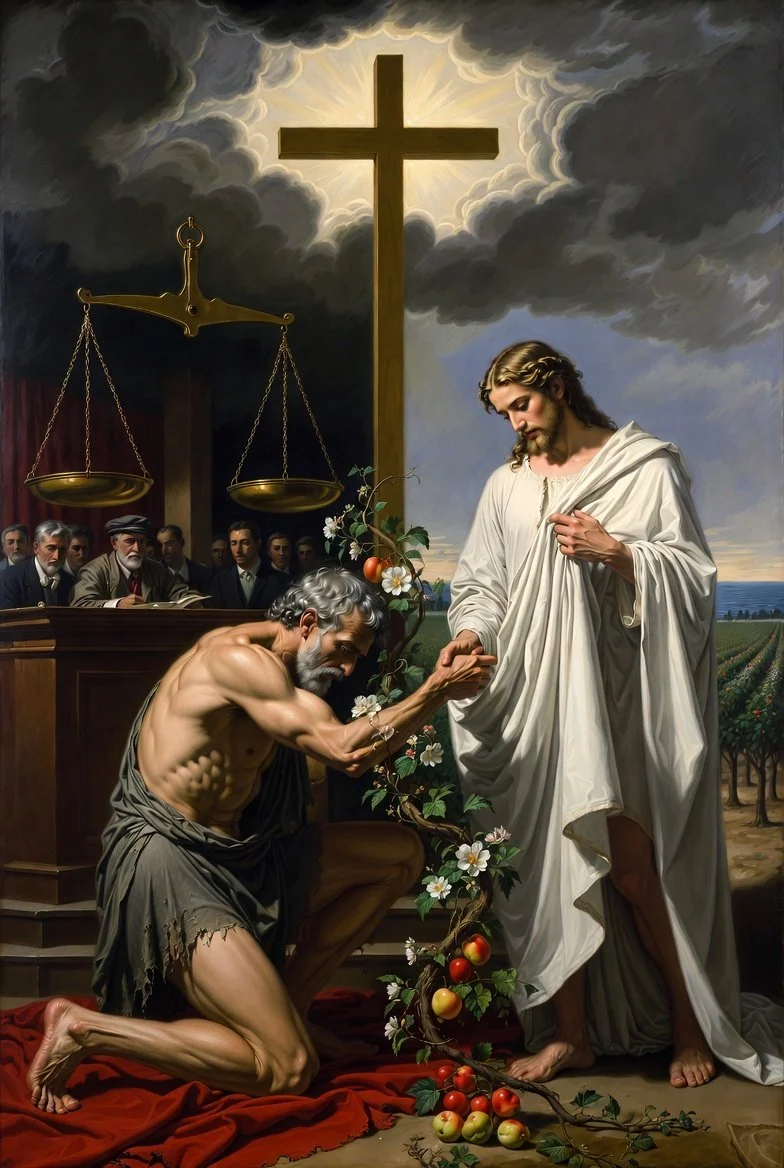
Christian Justification Explained
There is a question that haunts every honest heart sooner or later: How can someone like me, flawed, failing, and full of sin, ever be put right with a perfectly holy God? The Bible does not soften the problem. “All have sinned and fall short of the glory of God” (Romans 3:23). We sense the distance. We feel the weight. And deep down we wonder whether anything we could ever do would be enough to close the gap.
The good news of the gospel is that God Himself has answered that question once and for all. The answer is not found in what we achieve but in what God declares. This is the doctrine the church has called justification, the act by which a holy God puts sinful people into a right relationship with Himself. It is not a vague feeling of forgiveness. It is a real, legal, life-changing verdict spoken by the Judge of all the earth.
Let us walk through this truth together, step by step, the way a careful teacher might explain it to a new believer who simply wants to know: How does this work?
What Justification Actually Is
Justification is God’s declaration that the guilty sinner is now righteous in His sight. It is a forensic act, something that happens in the courtroom of heaven. When God justifies a person, He does not make them inwardly perfect on the spot (that is the lifelong work of sanctification). Rather, He pronounces them righteous. He looks at them and says, in effect, “Not guilty. Accepted. Right with Me.”
This is astonishing because it is the justification of the ungodly (Romans 4:5). God does not wait until we have cleaned ourselves up. He does not justify the already-good. He declares the bad to be right with Him. The tax collector in Jesus’ parable beats his breast and cries, “God, be merciful to me, the sinner!” And Jesus says that man went home justified (Luke 18:13–14). Not improved, justified.
Who Is Responsible? The Ground of Our Justification
The responsibility lies entirely with God. Justification is His act, rooted in His grace, accomplished by His Son, and applied by His Spirit.
At the heart of it all stands the Lord Jesus Christ. He lived the perfect life we never could. He died the death we deserved. On the cross the great exchange took place: “For our sake he made him to be sin who knew no sin, so that in him we might become the righteousness of God” (2 Corinthians 5:21). Christ took our guilt; we receive His righteousness. It is not our own righteousness that saves us, but Christ’s. This is why the apostle Paul can say that God “justifies the ungodly” (Romans 4:5). The righteousness that counts is not manufactured by us; it is given to us in Christ.
This is why justification is always connected to union with Christ. When we are joined to Him by the Holy Spirit, everything that is true of Jesus becomes true of us in a real, personal way. His death counts as ours. His resurrection life is now ours. His vindication before the Father is declared to be ours. We are not justified because we are lovely; we are justified because we are in the Beloved.
How Do We Receive This Justification? The Role of Faith
If God alone is responsible for the ground of justification, how does it become ours personally? The answer is faith, and faith alone.
Faith is the instrument, the open hand that receives the gift. The New Testament is crystal clear: “A person is justified by faith apart from works of the law” (Romans 3:28). Notice the little prepositions. We are justified by faith, through faith, on the basis of faith in the sense of the channel, but never on account of or because of faith as though our believing earned it. Faith does not create the righteousness; it simply lays hold of Christ, in whom the righteousness already exists.
This raises an important question for the thoughtful Christian: What part does my own will play? Am I just a passive spectator, or do I have real responsibility?
The Bible holds both truths together in a beautiful tension. Faith is a genuine human act. You believe. You entrust yourself to Christ. You say with your whole heart, “I am Yours.” It is not God believing for you. But, and this is crucial, faith is not something you generate out of your own unaided strength. It is the gift of God (Ephesians 2:8–9; Philippians 1:29). The same Spirit who opens blind eyes also opens blind hearts so that we see Christ as beautiful and trustworthy. Faith is active, but it is never contributory. It contributes nothing to the ground of our acceptance with God. It simply receives what Christ has already accomplished.
Think of it like this. A drowning man does not contribute to his own rescue by the strength of his grip on the life preserver. His grip is real and necessary, but the rescuer is the one who pulls him to safety. Faith is our grip, real, personal, responsible, yet the entire rescue belongs to God.
Even the weakest faith is enough, because what matters is not the strength of our faith but the strength of the Savior to whom it clings. The disciples in the boat cried out with “little faith” during the storm, yet they were still safe in the same boat with the same Lord who calmed the waves (Matthew 8:26). Abraham’s faith grew stronger over time, but it was the same God who counted him righteous from the beginning (Romans 4:3).
What About Good Works? Their True Place and Purpose
If justification is by faith alone, someone will naturally ask: Then what is the point of good works? Do they matter at all?
They matter enormously, just not in the way we sometimes fear. Good works are never the cause or ground of our justification. They do not earn God’s favor. They do not add to Christ’s finished work. To think otherwise would turn the gospel upside down.
Yet the New Testament is equally clear that genuine faith always produces good works. James puts it bluntly: “Faith apart from works is dead” (James 2:26). Paul and James are not contradicting each other; they are describing two different sides of the same reality. Paul fights against the idea that works can justify us. James fights against the idea that a faith which never works is real faith at all.
True faith is living. It unites us to Christ, and because we are united to Him, His life begins to flow through us. Good works are the fruit of that union. They flow from gratitude, not from fear. They are done not to get right with God but because we already are right with Him. They are the natural overflow of a heart that has been loved first.
The Bible even speaks of a future judgment according to works for believers (2 Corinthians 5:10). This is not a judgment that decides whether we are accepted or rejected. That question was settled at the cross and confirmed the moment we trusted Christ. This future assessment is more like a gracious evaluation of a life lived in union with Christ, an assessment that will publicly display the reality of our faith and assign rewards that are themselves gifts of grace. The servant in Jesus’ parable who was faithful with a little is given authority over much, not because his works earned the kingdom, but because the King is generous beyond measure (Luke 19:17).
In the end, good works have two great purposes. First, they give evidence that our faith is genuine. Second, they bring glory to the God who saved us. They are never the root of our acceptance; they are the beautiful fruit that grows from it.
The Freedom This Brings
When you understand justification rightly, everything changes. You stop living as though God’s love for you rises and falls with your spiritual performance. You stop measuring your standing before God by how strong your faith feels on any given day. You rest in the finished work of Christ, and from that rest you rise to serve Him with joy.
The God who justifies the ungodly is the same God who now walks with the justified through every storm. Your sins do not surprise Him. Your weak faith does not undo Him. Your best works do not impress Him into loving you more. He loved you when you were still His enemy, and He will keep on loving you until the day you see Him face to face.
So come as you are. Believe as you can. Trust the Savior who has already done everything necessary to make you right with God. And then, by the same grace that justified you, begin to live the new life He has given you, one day, one obedient step, one grateful work at a time.
That is the wonder of justification. That is the heart of the gospel. And that is the solid ground on which every Christian can stand, today and forever.
Allan Snodgrass serves the wider church with a rare blend of theological depth, pastoral steadiness, and the kind of hard‑won wisdom that only comes from years of walking with people through real suffering. His ministry has always lived at the intersection of Scripture and lived experience, where the text is not merely explained but carried into the wounds and questions of ordinary believers. As a writer, teacher, and counselor, he brings the Bible to bear with clarity and honesty, never rushing past the ache but always guiding people toward hope.
His ongoing work in the theology program at Westminster Theological Seminary deepens that ministry with rigorous study, shaping a voice that is both academically grounded and pastorally warm. Whether he is preaching on a Sunday morning, leading a retreat, speaking at a conference, or joining a podcast conversation, Allan’s aim is the same: to help the church wrestle honestly with God, see the gospel with fresh eyes, and find steady grace in the midst of life’s hardest moments.
If this work has encouraged you and you’d like to support Allan’s ministry, you can become a paid subscriber or make a one‑time donation by clicking the link. Your support helps sustain the writing, teaching, and pastoral care that so many have come to rely on.