
Becoming a Neighbor to the Broken: The Good Samaritan and the Ministry of Presence
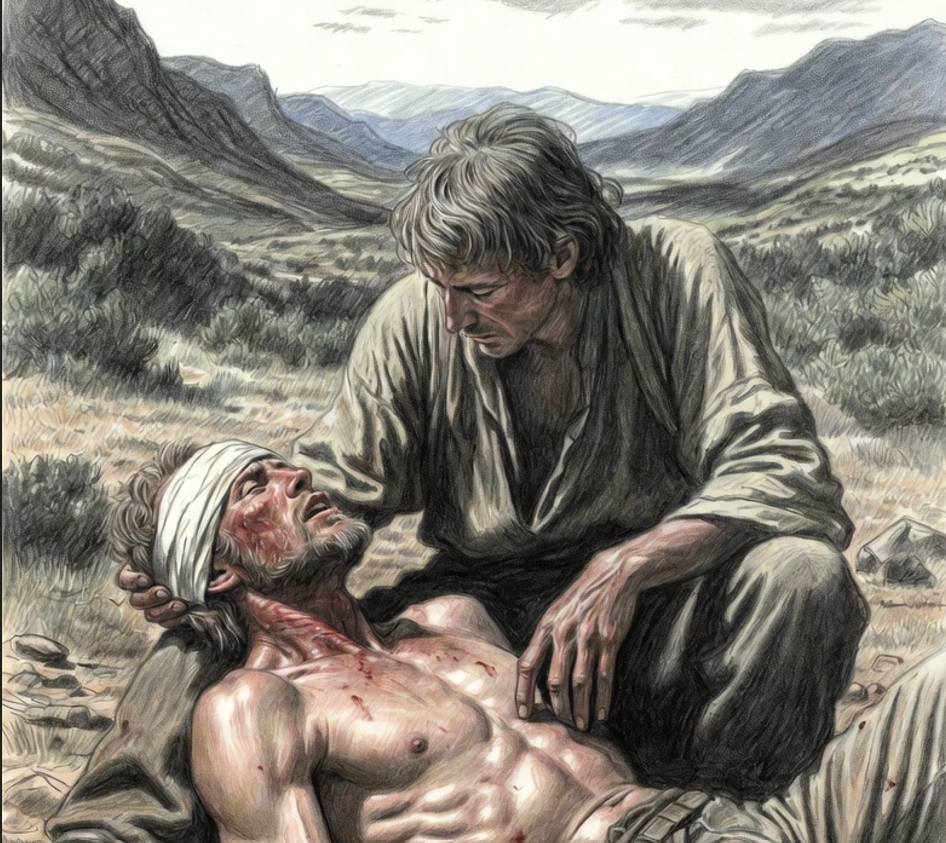
The Good Samaritan. Luke 10:30-37
The parable of the Good Samaritan is so familiar that we sometimes forget how jarring it is. Jesus tells of a man traveling the treacherous road from Jerusalem to Jericho who is suddenly attacked, stripped, beaten, and left half‑dead. A priest approaches, sees him, and deliberately passes by on the other side. A Levite follows and does the same. Then, in a narrative twist that would have stunned Jesus’ original audience, a Samaritan, an ethnic and religious outsider, draws near, sees the wounded man, is moved with compassion, and acts. He binds the man’s wounds, lifts him onto his own animal, brings him to an inn, pays for his care, and promises to return. Jesus concludes with a simple but searching command: “Go and do likewise.”
When we read this parable through the lens of tragedy, it becomes more than a lesson in generosity or cross‑cultural kindness. It becomes a reflection on what it means to be a friend to someone who is suffering. The man in the ditch is not a symbol or an allegory. He is the embodiment of the broken person whose life has collapsed, someone who cannot advocate for himself, cannot explain his needs, and cannot “fix” anything. He is the grieving parent, the betrayed spouse, the patient in the hospital bed, the friend whose world has been shattered. Jesus does not narrate the story from the victim’s perspective, but the parable invites us to imagine what it feels like to lie helpless on the side of the road, dependent on the mercy of another.
What the broken person needs is not a lecture, a theological explanation, or a carefully curated set of comforting phrases. He does not need someone who hovers at a safe distance, analyzing the situation or worrying about saying the wrong thing. He needs a neighbor, someone who draws near, sees him, and responds with compassion. Jesus redefines “neighbor” not as a category of people we are obligated to love, but as the kind of person who moves toward the wounded with genuine care.
Good analysis helps us see that the Samaritan’s actions are not motivated by a desire to earn spiritual credit. This is not a moralistic example story in which the hero performs a good deed to secure eternal life. The Samaritan acts because he is living out the love commands that shape the identity of God’s people: loving God with heart, soul, and strength, and loving one’s neighbor as oneself. His compassion flows from who he is becoming, not from what he hopes to gain. He sees the man, allows himself to be moved, crosses the distance between them, and does what the moment requires. There is no formula here, no script, no checklist of “best practices.” Love simply takes the shape demanded by the situation. Sometimes love binds wounds. Sometimes love pays for lodging. Sometimes love sits quietly in the dust beside the broken, offering nothing more than presence.
The priest and Levite are not villains. They are religious professionals caught between purity concerns, fear, and the costliness of involvement. Their failure is not rooted in hatred but in distance. They see the man but refuse to let his suffering become their responsibility. Their response warns us that suffering exposes whether our theology produces compassion or self‑protection. It reveals whether our faith draws us toward the wounded or gives us excuses to walk around them. Jesus is not attacking the Temple or purity laws; he is revealing that love, real, embodied, sacrificial love, is the fulfillment of the Law.
When someone is lying in the ditch of tragedy, what they need most is presence. Job’s friends were at their best when they sat with him in silence for seven days. Their ministry unraveled only when they felt compelled to explain, diagnose, or fix. The Samaritan shows us a better way. He pays attention, allows himself to be affected by another’s pain, moves toward the wounded, and serves the need that is actually present. He does not attempt to be the hero or to solve the entire crisis. He simply does what he can and entrusts the rest to God and the community.
One of the most radical elements of the parable is the identity of the hero. The Samaritan is the last person the lawyer expected to embody covenant faithfulness. Jesus deliberately chooses an enemy to demonstrate that love cannot be confined to categories, tribes, or comfort zones. The broken person on the road does not care about the Samaritan’s ethnicity, theology, or social standing. He cares that someone saw him and stopped. In tragedy, the boundaries we use to define “neighbor” collapse. The only question that remains is the one Jesus asks: “Who proved to be a neighbor?” The answer is always the one who draws near.
So what does this mean for us as we walk alongside those who suffer? It means slowing down enough to see people rather than rushing past their pain. It means allowing their grief to affect us, even when it disrupts our schedules or emotional equilibrium. It means serving the need that is actually present rather than the need we imagine or prefer. It means resisting the urge to be the fixer or the expert and instead embracing the ministry of presence. Above all, it means remembering that love is not a performance but an identity. We do not love to earn God’s favor. We love because God has already loved us, and because this is who we are becoming in Christ.
The parable of the Good Samaritan is not merely a call to help the hurting. It is a call to become the kind of person who naturally moves toward the broken because the love of God has taken root in us. When tragedy strikes, whether in our own lives or in the lives of those around us, the question is not, “What is the right thing to say?” or “How do I avoid making a mistake?” The question is, “How can I be a neighbor right now?” To be a neighbor is to draw near. To draw near is to love. And to love is to reflect the heart of the One who drew near to us in our own brokenness.