
Habakkuk’s Historical Context
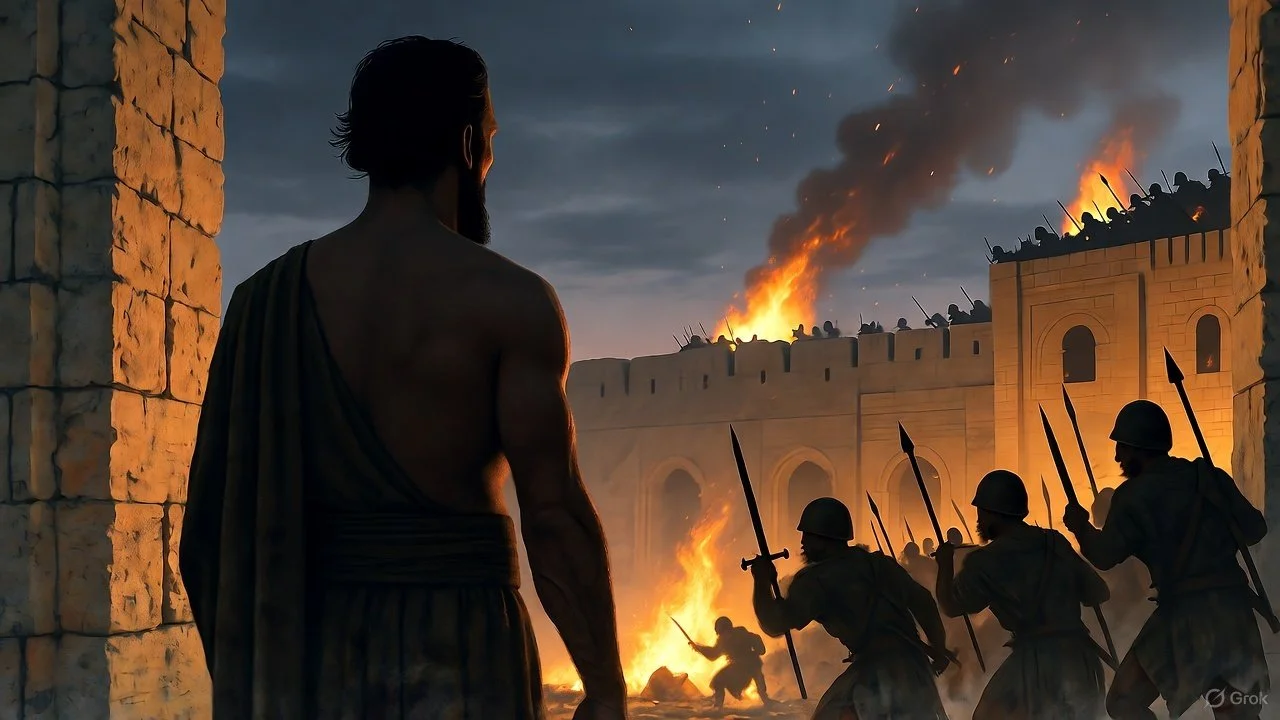
Habakkuk’s Tragedy and Historical Context
When tragedy strikes, the intellect arrives late. The senses insist the thing is real while the mind keeps saying it cannot be. Prayer erupts. The tragedy occurs anyway. Numbness and piercing awareness occupy the same hour. That collision is likely how Habakkuk felt as Jerusalem came apart, and it is why the opening of his book should not be read as theological analysis. The early verses are a raw outpouring, closer to a psalm of lament than to a dissertation. Some of what he says is true. Some of it is mistaken. The chaos is the point. To hear him, we have to feel the weather he was breathing.
The story unfolds in Jerusalem in the late seventh and early sixth centuries before Christ, as the city teetered under the threat of the Chaldeans. Nabopolassar had broken Assyria. Under Nebuchadnezzar II the new empire moved with ruthless speed. Rumors of what they did to cities circulated ahead of the army. God’s people feared the worst and prayed it would not come.
The campaign against Judah began with the fortified cities. Azekah and Lachish were not only military outposts but economic centers. Excavations at Lachish have turned up burn layers, collapsed walls, and concentrations of iron arrowheads consistent with Neo-Babylonian siege tactics. Among the finds were the Lachish Letters, ostraca written by a Judean officer named Hoshaiah in the final days. In one he reports that they are watching for the fire signals of Lachish, because they cannot see Azekah. The absence of those signals was a grim omen. If Azekah was gone, Lachish was next. Text and archaeology converge on the same picture: communication breaking, roads cut, defeat imminent.
After those cities fell, the Chaldeans turned to Jerusalem and began a siege around 588–587 BCE. They built an earthen ramp, the same method used at Lachish, designed to breach the walls. Second Kings records the result inside the city: the siege held until the eleventh year of Zedekiah, and on the ninth day of the fourth month the famine was so severe there was no food for the people. Cut off from Azekah and Lachish, Jerusalem could not replenish supplies. What little remained was often hoarded by the connected. Archaeological layers in the City of David and around the Western Hill show burn strata and collapsed structures consistent with the final assault. In 587/586 the walls were breached, the city and temple set on fire, resistance cut down. The biblical accounts in Second Kings, Jeremiah, and Lamentations are theological, but they are also trauma: famine, fire, enslavement, the unraveling of a nation.
Little is known of Habakkuk himself. Tradition places him in Jerusalem, possibly as a temple singer or priestly figure who counseled worshipers amid the turmoil. His anguish had two sources. The city was decaying from within. “The law is ignored, and justice never prevails,” he says. Leaders exploited the weak while the siege cut off food. Jeremiah condemned the same pattern. Lamentations gives the street-level picture: children crying to their mothers for bread and wine, fainting like the wounded, life poured out. Habakkuk would have seen families unraveling, the dying set against the indifference of the privileged.
The second source was the ramp itself. Each day it climbed. The Chaldeans were known for systematic destruction and little mercy. Night after night the sound of soldiers laboring on the earthwork carried into the city, a reminder of what would follow the breach. Starvation, betrayal inside the walls, and the dread of slaughter or exile sat on the same people. Habakkuk bore that weight as a prophet speaking for a community he shared the predicament with. His cries in the first chapter are the voice of a man asking how a just God could allow it.
Picture the end. The ramp nears completion. Famine has taken hold. When the city is broken into, Zedekiah and his men flee by night through the gate between the two walls, abandoning the people. The escape fails. His sons are executed before his eyes; then his eyes are put out; he is taken in chains to Babylon. Those left behind face the sack. The valuable are beaten and carried off. The weak and starving are cut down. I imagine the dialogue of the book unfolding in those final hours, the prophet’s silhouette against burning buildings, and then, somehow, the hymn of the third chapter sung while the horde overwhelms the city.
Under those circumstances the questions are not academic. Why are you ignoring my cries? When I scream violence, why do you do nothing? You are good; why this injustice? Why does tragedy happen and you do nothing? You are the Holy One; how can this be? Why are you silent while evil wins? Why have you made mankind so capable of evil and not overruled it? How long? I will stand here until you answer. These are not ivory-tower debates. They are life-and-death questions from a man who has nowhere else to turn. If they go unanswered, faith itself is on the table. Rest assured, answers exist. They are not the ones he first expects.
Beneath the questions sit assumptions. He assumes God should hear and intervene, and he is half right. The history of Israel is full of rescues: the sea, Gideon’s three hundred, and more. God is sovereign and does act. The clearest act is the incarnation and the resurrection. The error is the further assumption that divine engagement always yields the outcome we call positive. Job already knew the tension: the Lord gives and takes away; shall we receive good and not evil? Tragedy does not mean God is absent. It means more is at work than a limited perspective can grasp. A Leviathan reading says God reigns over a created order that is deeply broken, and that brokenness seeds tragedy, even as God enacts redemption through tragedy, including the cross.
He assumes that if God is good and in control, evil should not prevail. The question is honest. Psalm 73 envies the sleek prosperity of the wicked. If God made and sustains a beautiful world, how does evil coexist inside it? God does not shy from the question. Habakkuk also assumes, mistakenly, that God is disengaged. Sensory experience in a siege makes absence feel logical. Tied to his belief in goodness, he concludes that engagement would have meant action by now. Human limitation produces that conclusion. It does not make it true.
Finally, he assumes retribution as a system: good deeds yield good outcomes, bad deeds bad ones, God as a kind of vending machine. He can speak of God as “my God,” as if obligation ran upward. David made a similar mistake when he planned a house for the Lord and was told the Lord would build him a house. We are God’s people. He is not ours to command. Habakkuk believes Jerusalem’s people are the righteous and the Chaldeans the wicked, so reward and punishment should sort accordingly. God’s response will correct that. For now the assumption is understandable, heartfelt, and mistaken.
Confusion in such an hour is normal. Peter, in Gethsemane, drew a sword and cut off an ear. Later he denied Jesus three times. He had seen miracles and conflict; he had not seen how quickly the story would turn toward a cross rather than a throne. In the chaos he could not hold the larger picture. God is bigger than the movement of pieces on the board. There is always more happening in a tragedy than we perceive in the moment. What appears senseless may belong to a redemptive story we cannot yet see, perhaps could not comprehend even if it were explained.
The world remains a Leviathan we cannot tame. That does not mean God is absent or out of control. His wisdom is deeper than ours. He is not bound by our expectations, and He does not owe an explanation that fits our framework. This does not make Him malicious. It means He is perfect and we are not. The pain is still real. Habakkuk is right to ask, flawed though the questions are. God does not rebuke the asking. He responds, corrects, offers glimpses, and invites deeper trust.
Our confusion can become the soil in which that trust grows. There is no tragedy He cannot redeem, no dark He cannot meet with light. We may feel that a good God could not be involved, that we do not deserve this, that evil is winning. Those are natural responses, symptoms of a limited perspective. They do not diminish His sovereignty. He has always been in command of the chaos. On the strength of that record we can lean in, even when we cannot see straight.